......................................................................
Five Years:
Unit 2B1 Boothby Road, Archway, London, N19 4AJ
subscribe to mailing list | facebook | @fiveyearsarchway
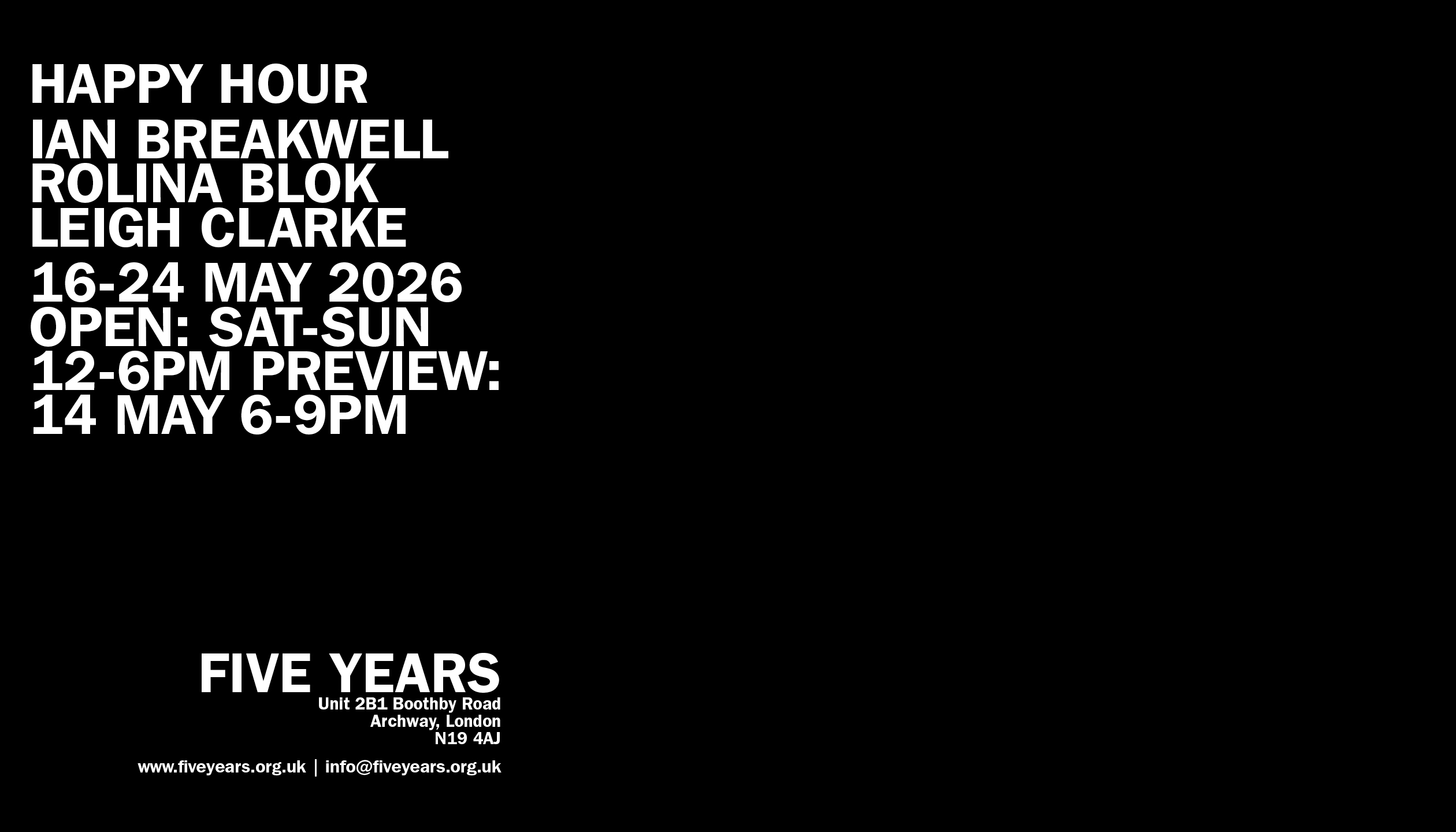
Happy Hour
Ian Breakwell, Rolina Blok, Leigh Clarke
16-24 May 2026
Open: Sat-Sun 12-6pm
Preview: 14 May 6-9pm
...........................................................
Happy Hour at Five Years
First Drink
I first met Ian Breakwell in a venue above Spitalfields Market in 2000 where we both performed in a curated, vaudeville-like event. Ian read from his iconic diary texts and I performed mouth percussion with songs under the pseudonym Reg Perfect (I try to keep all things anchored in print). We became friends, and I met him at The Rochester Castle in Stoke Newington to discuss an exhibition I was curating.
He had been a regular there for many years, settling in for one or two bitters, strictly with a beer mat, smoking and conversing with artists, writers, filmmakers, and musicians. The pub was not your typical cool gastropub with red leather Chesterfields and young hipsters; this was J.D. Wetherspoon’s third pub and a testing ground for the chain we now know. Before the change of management, Ian told me of the time the regulars were warned of the coming takeover. No music, no sport, and they would serve food. To the barflies, this concept was worrying and reminiscent of George Orwell’s character George Bowling reflecting on “progress” in Coming Up for Air. Ironically, the historical text on the Wetherspoon menu at The Moon on the Hill in Sutton states: “Several Wetherspoon pubs have ‘Moon’ in their name, linking them with the ideal pub described by George Orwell. The famous author called his fictitious pub ‘The Moon Under Water’.”
I asked Ian why, with all the pubs in the area, he chose to continue drinking there most evenings. He looked at me with that mischievous eye of his and said, “Listen.”
Despite the criticisms Wetherspoons receives, a distinct difference to other pubs is the cacophony of diverse voices. Babies, children, students, labourers, office workers, creatives, pensioners, and, of course, nice people and lunatics frequent them for an affordable experience. With the loss of social clubs in the UK, Wetherspoon pubs have, like it or not, become cultural melting pots for local communities. ‘This was accurately observed in the Radio 4 play Happy Hour by Liv Fowler, where two ‘bezzies’ tackle topics of sexual harassment in their local ‘Spoons.’In the book You’re Not Listening: What You’re Missing and Why It Matters, Kate Murphy encourages us to listen better, particularly in an age of constant distraction. She notes, “If anyone tells a story longer than 30 seconds, heads bow not in contemplation but to read texts, check sports scores or see what’s trending online.” Ian Breakwell died in 2005, a few years before smartphones became a standard accessory. I recently returned to The Rochester Castle to contemplate this exhibition and wondered how Ian would have responded to the ringtones, scrolling streams, and disengaged drinkers in the pub today. My etching in this exhibition is drawn from the photograph on the menu.
Happy Hour
I met Rolina Blok in 2012 when I was a Visiting Lecturer in Printmaking at London Metropolitan University. What struck me about her artwork was how her rigorous practice as a kickboxer ignited her printmaking. My favourite artists involved in print have always been those who think beyond the craft, breaking conventions in ideas while remaining subservient to the machine. There are printmakers led by the process, and those who lead the process through ideas. Rolina is the latter, and after a life-altering illness in 2024, the artist returned to foundational practices, not just to see, but to listen to the quiet demands of recovery. A body of charcoal drawings and prints served as an act of deep listening to herself and her environment. By moving away from the noise of certainty, Rolina used the motif of the eye to tune into the frequency of vulnerability and non-hierarchical connection. The work originates from a performance installation (REHEARSAL) and drew from the disorienting forest sequence in Snow White. Here, the disembodied eyes are not mere observers; they are organs of receptivity, navigating fear through a total immersion in the surroundings. Emerging from charcoal darkness, these “monsters” or “critters” function as empathic listeners to our collective cultural anxieties.
Printmaking is a great broadcaster; the dissemination of information and performance can be a beautiful marriage. Ian knew this, which is why throughout his Diary, he used reprographic techniques to deliver his art. His ability to cross-fertilise print and performance was apparent in the exhibition Circus, commissioned by the Third Eye Centre in Glasgow (now the CCA) in 1978. The exhibition consisted of 16 large silkscreen prints, two of which are in this show. Breakwell collaborated with composer Ian McQueen, who created a 25-minute electronic piece titled Breakwell’s Circus (1979), featuring Ian reading his text, Circus: Sixteen Animal Acts, against variations of Liszt’s First Piano Concerto.
Reg Perfect had a good run during the noughties. I beatboxed songs about having a small hand, eating chicken in a box, and “saving the kids from Michael Jackson.” For me, the mic and amp were a filtration system for ideas, much like a screen-printing press. Now and again, Reg comes out of retirement, but these days he’s more like an annoying uncle at a wedding. However, those years of treading the boards and confronting audiences inspired the dancing figures in my new prints. For Ian, audiences were a constant subject, best seen in his 1993 film Auditorium, where he turns the camera on the voyeurs themselves.
Last Orders
Shortly before Ian died, he asked me back to The Rochester Castle to discuss another project. His voice was a whisper due to medical treatment; he gave me meticulous instructions and then began a story. When Ian spoke, you listened.
He told me he had been invited to give a talk in Leeds and arrived early to prepare. He walked into a nearby bar that was empty aside from a young bartender. He asked for a pint of bitter, but the tender said they only served lager. Ian asked for a pint of lager; the tender informed him they only served bottles. Ian ordered a bottle and asked for a beer mat. The tender told him they didn’t have beer mats. Ian sat alone and began a crossword. Later, with the bar still empty, the bartender ramped up some banging dance music, much to Ian’s horror. Confused, Ian asked why the music was so loud when there were no customers. “It’s happy hour”, the bar tender replied.
After telling me this tale, Ian stood up and left without saying goodbye. It was the last time I ever saw him. He left me with the greatest gift: a story. He knew the viral nature of the pub narrative—gossip, jokes, barstool preaching, and “jibber-jabber.” This is grassroots knowledge exchange: the gifting of anecdotes through timing, delivery, and engagement. It is a culture not dissimilar to that of a print workshop, something Rolina and I experience in our teaching roles. It was likely something Ian enjoyed while screen-printing the Circus works at Glasgow School of Art in 1978.
Kate Murphy wrote, “Listening is active. The best listeners focus their attention and recruit other senses to the effort... finding meaning, which opens the door to creativity, empathy, insight, and knowledge.” It is common to hear people talk about what an image is “saying” or how it “speaks” to them. Perhaps if an artwork resonates with us, it is because it is doing less speaking and more listening.
Leigh Clarke 2026